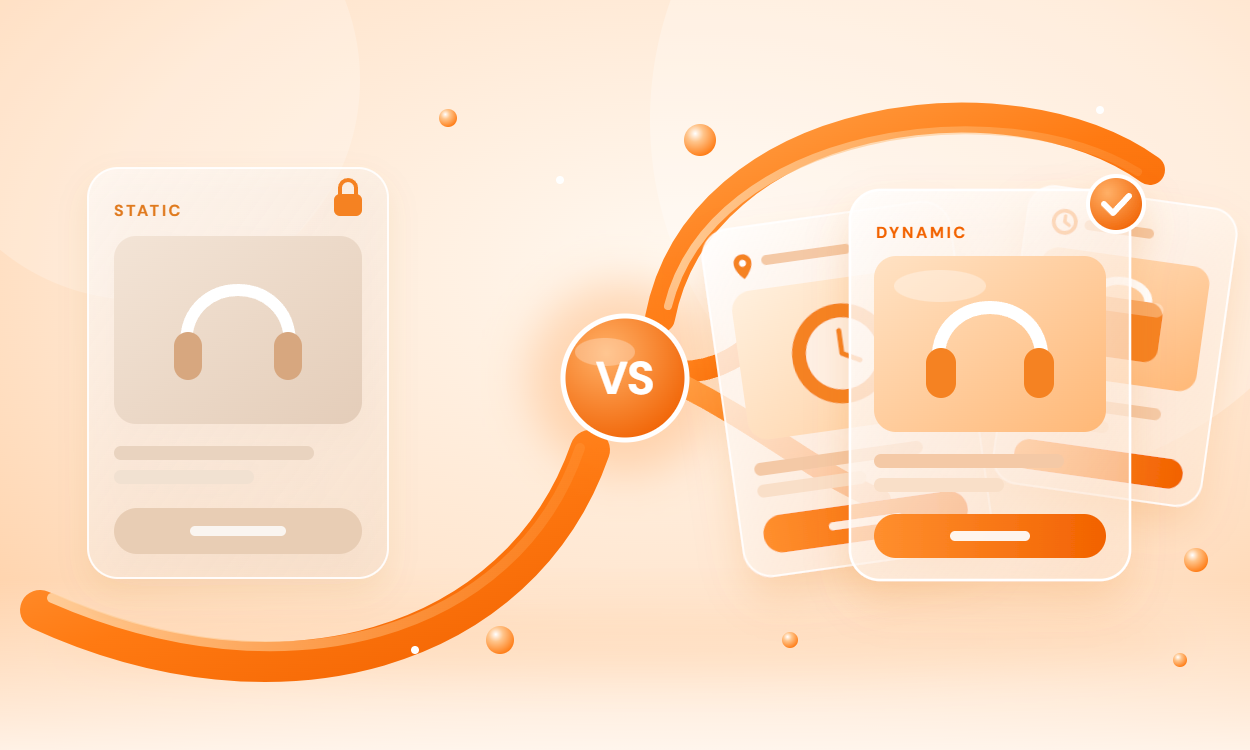
A display ad is made up of several creative elements: an image, a headline, a message and a call to action. How these elements are created, combined and delivered can influence the creative experience an ad campaign offers.
With static creative, these elements are arranged into a finished ad. With Dynamic Creative Optimisation (DCO), approved elements can be combined in different ways to produce creative variations in real time.
Both approaches have a place in programmatic advertising. The difference lies in how creative is structured, controlled, tested and updated.
For agencies, understanding these differences helps inform creative briefs, approval processes and campaign measurement. Here is how static creative and DCO compare in practice.
What is the difference between DCO and static creative?
Static creative uses a fixed combination of image, headline and message in each ad version. DCO combines approved images, headlines and other creative elements to generate different ad variations, using available audience data and campaign signals to make the creative more relevant.
The difference is not simply between one ad and many. A static campaign can include multiple versions, each created manually. DCO assembles creative elements dynamically, so advertisers can generate different combinations without designing every version as a separate finished ad.
| Creative consideration | Static creative | DCO |
| Creative structure | A finished design for each version | A template that combines approved creative elements dynamically |
| Messaging and visuals | Fixed within each version | Can vary based on configured rules, available audience signals and campaign data |
| Design changes | Usually require editing or creating another version | Creative elements, product data and rules can be updated within the configured setup |
| Brand control | Each finished version can be reviewed individually | Templates, assets and permitted combinations need to be reviewed |
| Creative testing | Separately created versions can be compared | Multiple combinations of creative elements can be tested and optimised |
| Reporting | Performance can be compared by creative version, depending on the reporting setup | Performance reporting can provide granular data; element-level breakdowns depend on available reporting capabilities |
DCO capabilities vary by platform and implementation. The level of creative assembly, testing, optimisation and reporting available depends on how the solution is configured.
How does creative execution differ between static ads and DCO?
Consider a UK retailer launching a seasonal homeware collection. The campaign needs to promote several products through display advertising while maintaining a consistent brand identity.
Creating static ads
The designer develops a finished banner featuring a selected product image, headline and call to action.
If the client wants to promote another product or change the headline, the team creates another version. Each design can be reviewed and approved before it goes live.
This approach gives the agency direct control over each finished composition. It is straightforward when the campaign has a limited number of creative versions.
However, every additional version needs to be produced, reviewed and managed separately.
Using DCO
The designer creates a template with approved elements, such as product images, headlines, promotional messages and calls to action.
The DCO setup uses these elements and its configured rules to assemble different creative combinations. Depending on the implementation, product data and user signals can also inform which elements are served.
Instead of treating every variation as a separate finished design, the agency manages a set of approved assets and rules.
This changes the creative workflow. The team needs to consider how individual elements work together, which combinations are permitted and how the resulting ads appear across supported formats.
Static creative gives the team control over each finished version. DCO provides flexibility through a system of controlled creative components.
Which offers more creative control: DCO or static ads?
Neither format removes the need for creative direction. They approach control differently.
With static ads, the design team can review the complete composition before launch. The headline, image, product placement and call to action are fixed within that version.
This can be useful for campaigns with precise art direction, tightly controlled messaging or a visual concept that should remain unchanged.
DCO requires a different approach. Rather than reviewing only individual finished ads, teams need to establish rules for how approved elements can be combined.
For example, a retailer may approve several product images and headlines but require certain promotional messages to appear only with specific products. The DCO setup needs to respect those restrictions.
A sound creative review process should consider:
- Approved assets: Are the images, headlines, offers and calls to action accurate and suitable for use?
- Permitted combinations: Can the selected elements work together without creating misleading or contradictory messages?
- Brand consistency: Do the resulting variations follow the client’s visual identity and tone of voice?
- Format requirements: Will the creative remain legible and well-composed across the intended ad sizes?
- Quality assurance: Have representative combinations been checked before the campaign launches?
DCO does not mean giving up creative control. It means establishing controls at both the asset and template level, rather than relying only on reviews of individual finished designs.
How does creative testing differ between static ads and DCO?
Creative testing helps agencies understand which messages and visual approaches work best for a campaign. Both static creative and DCO can support testing, but the process differs.
With static ads, agencies can create separate versions to test a particular variable. For example, they might compare two headlines while keeping the image, offer and call to action consistent.
This can make the comparison easier to interpret because the versions have a clearly defined difference.
DCO can test combinations of creative elements, depending on the platform’s capabilities and optimisation settings. This offers flexibility, but it also requires careful interpretation.
Suppose a retailer has three approved product images and two headlines. A DCO setup could potentially combine these into six image-and-headline variations, provided the combinations are permitted.
The agency would need to consider whether the campaign generates enough delivery to distinguish meaningful differences and whether the platform provides reporting at the required level.
There is also a distinction between testing and optimisation. A platform may favour combinations based on its optimisation logic, but that does not automatically establish why a combination performed better or prove that it will work equally well in every context.
The testing approach should match the question the agency wants to answer. A controlled comparison of two specific messages may be easier to interpret with deliberately designed versions. A campaign requiring numerous combinations may benefit from DCO’s more flexible approach.
What happens when creative needs to change mid-campaign?
Campaign creative can change after launch. Clients may revise messaging, update offers or replace assets as a campaign progresses.
With static ads, a change may require the designer to update the original file, export a new version, obtain approval and replace the existing asset in the campaign.
For a small number of ads, this is manageable. When multiple versions need the same change, the process can become repetitive.
With DCO, some changes can be handled by updating an approved asset, product feed or configured rule, depending on how the campaign is built. The updated element can then be reflected in the creative combinations that use it.
This does not mean every change happens automatically or can bypass approval. Teams still need to validate data, check the resulting creative and confirm that updates are reflected correctly in live ads.
The difference is how the work is organised. Static creative generally requires changes to individual finished versions, while DCO can allow certain changes to be managed through shared assets and rules.
How should agencies measure static creative and DCO?
A fair comparison needs more than a glance at click-through rates.
Agencies should start by identifying what the creative is expected to achieve. A brand awareness campaign may prioritise reach and engagement, while a performance campaign may focus on conversions, cost per acquisition or return on ad spend.
For static creative, agencies can compare individual versions to understand which designs or messages perform better.
For DCO, available reporting may allow teams to examine creative combinations or individual elements. The level of detail varies by platform, so agencies should establish what can be measured before the campaign starts.
When comparing the two approaches, consider:
- Comparable delivery: Differences in audience, placement, spend and frequency can affect results.
- Consistent objectives: Use the same primary success metric when assessing creative effectiveness.
- Sufficient evidence: Avoid drawing firm conclusions from small or uneven samples.
- Context behind performance: A creative element may perform differently depending on the other elements with which it appears.
- Business outcomes: Interpret engagement alongside the campaign’s broader objectives.
A comparison is most informative when the agency understands what changed between the approaches and what the available evidence can support.
5 common mistakes to avoid when choosing a creative format
Regardless of the format, several mistakes can undermine creative execution.
Assuming every DCO combination will work. More possible variations do not automatically mean better advertising. Assets need to work together, and rules should prevent unsuitable combinations.
Assuming static creative cannot be tested. Static ads can support structured creative testing. The distinction is how the versions are built and managed, not whether testing is possible.
Changing too many variables at once. When images, headlines, offers and calls to action all change together, it can be difficult to understand what contributed to a performance difference.
Overlooking the approval process. Both approaches need brand and compliance checks. DCO also requires teams to consider combinations that may not have been designed as separate finished ads.
Choosing a format before defining the creative brief. The audience, message, assets and intended outcome should guide the setup. Starting with technology can lead to unnecessary work.
So, which is better: DCO or static creative?
Static creative offers direct control over finished designs and a straightforward way to manage a limited number of versions. DCO offers a more modular approach, allowing approved creative elements to be assembled into different combinations and, where supported, optimised using campaign data.
The differences become most apparent in creative execution, approval, testing and ongoing updates. Static ads make each version easier to inspect as a finished design. DCO can make multiple combinations easier to manage, provided the assets, rules and quality checks are properly configured.
For agencies, the decision starts with the creative brief. Consider how much variation is needed, how the team will maintain brand consistency, what needs to be tested and how results will be evaluated.
Neither format is automatically the better choice. The objective is to select the creative approach that fits the campaign’s requirements and gives the team a manageable way to produce, review and evaluate the ads.
FAQ: DCO vs static ads
Is DCO better than static ads?
Not always. Static creative works well when a campaign has one consistent message. DCO is useful when different audiences, products or campaign signals call for different creative variations. The right approach depends on what the campaign needs to achieve.
What is the difference between DCO and A/B testing?
A/B testing compares defined ad variants to understand which performs better. DCO dynamically combines creative elements, such as images, headlines and calls to action, and can use performance data to optimise the combinations served. The exact testing and optimisation capabilities depend on the platform and campaign setup.
What is the difference between dynamic ads and DCO?
Dynamic ads use data to change elements of an advertisement, such as a product image or price. Dynamic Creative Optimisation (DCO) brings creative assembly and optimisation together, allowing different combinations of approved elements to be selected based on configured rules and available signals.
How long does it take to set up DCO?
Setup time depends on the campaign’s data sources, creative assets, templates and approval process. With Vizibl DCO, the service is fully managed. The team handles data feeds, creative logic configuration, dynamic templates and ongoing optimisation. Contact the team to discuss your campaign requirements and setup timeline.
Can I run static and dynamic creative together?
Yes, where the campaign setup supports both. Advertisers can use static ads for consistent brand messaging and DCO for campaigns that benefit from more personalised creative, such as product retargeting. The two approaches can serve different objectives within the same media strategy.
Do I need a lot of creative assets for DCO?
Not necessarily, but you need suitable creative elements that can be combined within the chosen template. Requirements depend on the campaign’s objectives, the variations you want to deliver and the data available. A clear asset plan helps ensure the combinations remain relevant and consistent with brand guidelines.