Ask most media buyers when to use DCO, and you’ll get the same answer: “when the budget’s big enough.”
It’s a reasonable-sounding rule. It’s also wrong.
Many agencies associate Dynamic Creative Optimisation (DCO) with enterprise retailers, extensive product catalogues, and large-scale campaigns that rely on hundreds of creative variations. As a result, it’s often viewed as a capability that’s only worthwhile once media budgets reach a certain threshold.
But the reality is more nuanced.
A smaller campaign doesn’t automatically mean simple creative requirements. An eCommerce brand may want to retarget shoppers with the exact products they viewed but didn’t purchase. A retailer might need location-specific offers across multiple stores. A travel advertiser could benefit from promoting different destinations based on audience interests or browsing behaviour.
These campaigns don’t necessarily require larger budgets but more relevant creatives.
Within a programmatic advertising campaign, that’s where DCO adds value. Instead of serving the same display ad to every user, DCO dynamically assembles creative using signals such as browsing behaviour, product feeds and campaign rules. This enables agencies to deliver more relevant display advertising without manually producing and managing every creative variation. It should help agencies scale personalised display retargeting while reducing the operational effort involved in managing dynamic creatives.
Before recommending Dynamic Creative Optimisation to their clients, agencies need to answer a few practical questions.
The answers depend far more on campaign strategy than budget size alone.
What Exactly Is Dynamic Creative Optimisation?
DCO is a system that builds ads on the fly by combining modular creative pieces like images, headlines, prices, offers, CTAs with real-time signals like audience segment, location, or browsing behavior, according to rules you set up in advance.
Instead of a designer manually producing every version of an ad, the system assembles the right combination for each impression automatically.
The flow looks roughly like this:
Signal comes in → rules apply → creative elements get selected → ad is assembled → impression serves → performance gets measured
The “creative elements” in that chain are usually things like:
- Product shots or lifestyle images
- Headlines and subheads
- Prices and offers
- CTAs
- Backgrounds and brand elements
Here’s why this matters more than people assume: it’s not really about “showing different people different ads.” Plenty of campaigns do that manually with a handful of variants. DCO’s actual value shows up when the number of combinations gets too large to build by hand.
Take a campaign with 4 audience segments, 3 products, 2 offers, 2 CTAs, and 3 formats. Multiply that out and you get 144 possible ad combinations. Nobody’s designing 144 static ads for one campaign. But DCO can assemble all of them from a much smaller set of modular parts.
That’s the moment creative complexity starts outweighing media spend as the thing that matters.
TL;DR
- Not every small campaign needs DCO. If there is one audience, one product, one offer, and one message, static creative may be the better choice.
- Budget alone is a poor indicator of DCO readiness. A smaller campaign can still have enough creative complexity to justify DCO.
- DCO is most valuable when different audiences need different messages, products or offers change frequently, or multiple creative variations would otherwise need to be managed manually.
- DCO doesn’t create relevance by itself. It depends on useful audience signals, accurate product or campaign data, good creative assets, and sensible rules.
- The operational benefit can matter as much as the performance benefit, particularly for agencies managing multiple clients and campaigns.
- The smartest approach isn’t to use DCO everywhere. It’s to use it where automation and creative relevance solve a genuine campaign problem.
Does DCO Only Make Sense for Large Campaigns?
No. Campaign size alone shouldn’t determine whether agencies invest in DCO.
One of the biggest misconceptions about DCO is that it only delivers value when media budgets are substantial. In reality, budget is only one factor in the decision. Campaign objectives, audience diversity, creative complexity and the need for personalised messaging often have a much greater influence on whether DCO will improve campaign performance.
Imagine two retail advertisers investing similar amounts in display advertising. One is promoting a single nationwide offer using the same message for every audience. The other wants to retarget website visitors with the exact products they viewed, update pricing automatically and promote different offers based on customer behaviour.
Although both campaigns have identical budgets, their creative requirements are fundamentally different.
The second campaign is far more likely to benefit from Dynamic Creative Optimisation because manually producing and managing every creative variation quickly becomes inefficient. DCO automates much of that process, helping agencies deliver more relevant advertising while reducing the operational effort required to keep campaigns up to date.
This is why agencies shouldn’t evaluate DCO based on media spend alone. A more useful question is whether more relevant creative is likely to improve campaign performance. If it is, DCO may be a worthwhile investment regardless of campaign size.
Does Every Small Campaign Need DCO?
Not necessarily.
Like any programmatic capability, DCO should solve a specific business or campaign challenge. It isn’t something agencies should recommend simply because it’s available.
If a campaign promotes a single product, targets one audience and delivers one consistent message throughout its duration, static creative may be all that’s needed. Adding DCO in these situations can introduce unnecessary complexity without significantly changing campaign performance.
Many smaller campaigns, however, are far more dynamic than they appear.
An eCommerce advertiser may want to retarget users with the products they abandoned. A retailer may need different creative for different store locations or promotional periods. A travel company may want destination-specific messaging, while a B2B advertiser may need different creative for different industries or buying stages.
These campaigns aren’t more complex because of the budget but because different audiences are more likely to respond to different messages.
This is where DCO becomes valuable. By dynamically assembling creatives using audience signals and campaign data, agencies can deliver more relevant display ads without manually creating dozens of individual variations. That makes it easier to scale personalised campaigns while keeping creative management efficient.
When Does DCO Deliver the Best Results?
Dynamic Creative Optimisation delivers the greatest value when campaign performance depends on showing the most relevant message to each audience.
One of the strongest use cases is display retargeting. When a shopper leaves an eCommerce website after viewing specific products, showing a generic display ad often does little to encourage them to return. Displaying the exact products they viewed, together with updated pricing or a relevant call-to-action, creates a far more contextual advertising experience.
DCO is also particularly effective for campaigns that involve multiple audience segments, changing promotions or frequently updated product catalogues. Instead of rebuilding creatives every time an offer changes, agencies can use dynamic templates that automatically update creative elements while maintaining brand consistency.
Another advantage is operational efficiency. As agencies manage more clients and campaigns, manually producing multiple creative variations quickly becomes resource-intensive. DCO helps reduce that workload by automating creative assembly, allowing teams to deliver personalised display advertising at scale without proportionally increasing production effort.
Ultimately, the value of DCO is that it enables agencies to make every impression more relevant while keeping campaign management efficient. Something that’s increasingly important as clients expect stronger results from every advertising pound they invest.
When Is DCO Not the Right Choice?
While DCO can improve campaign relevance, it isn’t the right solution for every campaign and that’s an important distinction.
If a campaign revolves around a single product, targets one clearly defined audience, and uses one creative message from start to finish, introducing DCO may not deliver enough additional value to justify the extra planning involved.
For example, a local business promoting a one-time event or a brand running a short awareness campaign with a single creative concept may achieve its objectives using well-designed static display ads.
The same applies when there is little variation in what audiences need to see. If every user receives the same message regardless of their behaviour, location or interests, dynamic creative has very little to optimise.
This doesn’t mean DCO isn’t effective. It just means agencies should introduce it when it solves a genuine campaign challenge rather than because it’s available as a capability.
The strongest media strategies are rarely built by using every available feature. They’re built by choosing the right capabilities for the campaign in front of you.
5 Questions To Ask Before Taking On DCO
Skip the “is this campaign big enough” instinct. Run it through these five questions instead.
- How many audiences need a genuinely different message? If every segment can see the same ad without losing relevance, you don’t need DCO for this. If a returning customer, a first-time visitor, and a high-intent shopper all need different angles, that’s a point in DCO’s favor.
- How many products, offers, or messages actually need representing? One SKU and one promo is a non-issue manually. Dozens of SKUs, rotating promotions, or messaging that shifts weekly is a different story entirely.
- How often will the creative need to change? Set-it-and-forget-it campaigns don’t need automation. Campaigns where prices, stock, or offers move constantly do because every manual update is an hour someone isn’t spending on strategy.
- Do you actually have signals worth personalising against? DCO needs something real to react to: products viewed, category browsed, location, audience segment, feed data. No signal, no personalisation — the engine has nothing to work with.
- Would automating this save real time? This is the one agencies underweight. If your team would otherwise be manually producing, uploading, QA-ing, and updating dozens of creative combinations, the operational payoff can be worth it even when the client’s budget is modest.
How Should Agencies Decide Whether to Invest in DCO?
Rather than asking whether a campaign budget is “large enough” for DCO, agencies should evaluate whether the campaign itself creates a need for more relevant creative.
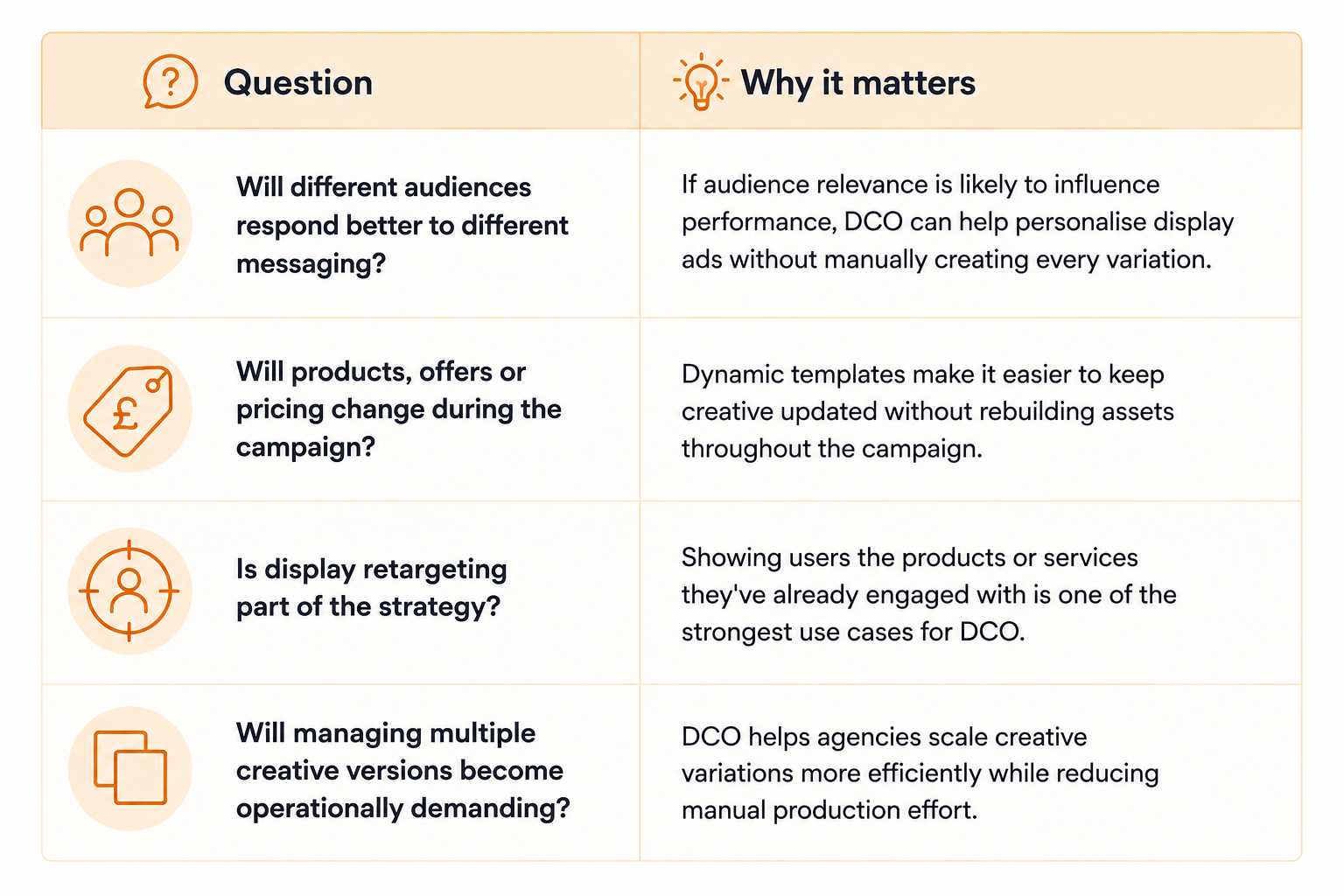
None of these questions focus on budget. They focus on whether creative relevance is likely to improve campaign performance.
Does DCO Save Agencies Time as Well as Improve Performance?
One of the biggest benefits of Dynamic Creative Optimisation is that it changes how agencies manage campaigns.
Without DCO, launching multiple creative variations often means producing separate assets, uploading individual creatives, scheduling updates manually and coordinating changes between creative and media teams throughout the campaign.
As campaigns become more sophisticated, that workload grows quickly.
DCO reduces much of that operational overhead by allowing creative elements to update dynamically based on campaign rules and audience signals. Instead of rebuilding creatives every time a product, promotion or call-to-action changes, agencies can focus more of their time on optimisation, testing and overall campaign strategy.
For lean agency teams managing multiple clients, that operational efficiency can be just as valuable as the performance improvements DCO helps unlock.
Questions Agencies Ask About DCO
Does Dynamic Creative Optimization (DCO) increase campaign costs?
Not necessarily. While DCO may require additional planning and creative setup, it can also reduce the manual effort involved in producing and managing multiple ad variations. Whether it’s a worthwhile investment depends on the campaign’s objectives, audience complexity, and the value personalised creative is expected to deliver.
Is DCO only useful for large advertisers?
No. Although DCO is commonly associated with enterprise campaigns, smaller advertisers can also benefit when campaigns involve multiple audience segments, product catalogues, location-based messaging, or display retargeting. The deciding factor is the campaign’s creative requirements and not the size of the media budget.
What’s the difference between static display ads and DCO?
Static display ads show the same creative to every user throughout a campaign. Dynamic Creative Optimization (DCO) automatically adapts creative elements—such as images, product recommendations, offers, or calls-to-action—based on audience data, campaign rules, or user behaviour, making ads more relevant to each individual.
Can DCO improve display retargeting campaigns?
Yes. One of the strongest applications of DCO is display retargeting. Instead of showing every returning visitor the same generic ad, DCO can dynamically serve creatives featuring the products or categories a user previously viewed, helping make retargeting ads more relevant and potentially improving engagement and conversion rates.