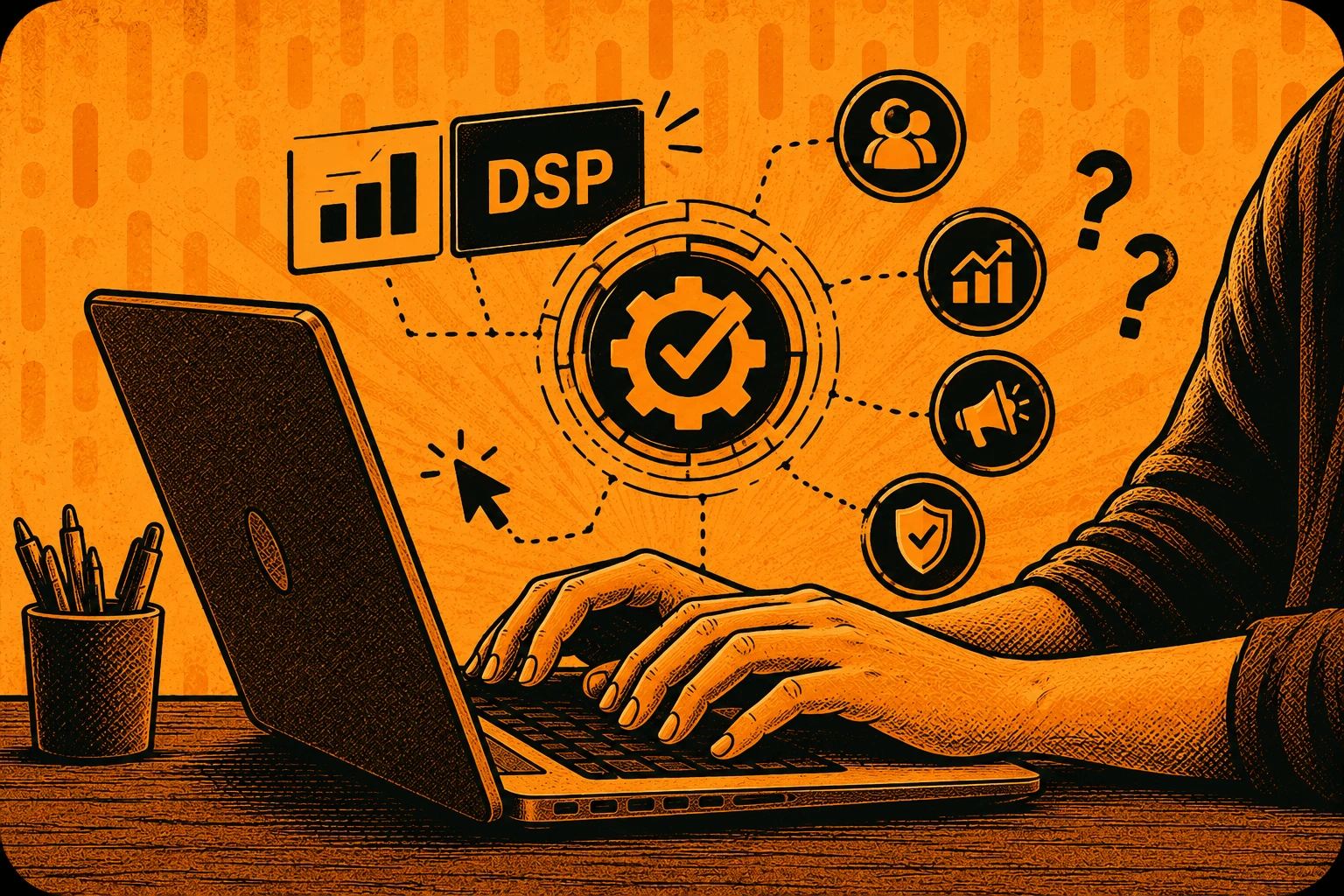
Choosing a Demand-Side Platform (DSP) was relatively straightforward a few years ago. Agencies evaluated a handful of platforms, compared inventory access, targeting capabilities, reporting features, and pricing, and selected the option that best aligned with their clients’ media plans.
Today, that decision is far more complex.
The number of programmatic advertising platforms has grown significantly, and many of them now offer similar core capabilities. Most provide access to premium inventory, audience targeting, AI-driven optimisation, and campaign reporting. On paper, they often look remarkably alike.
Yet agencies continue to ask the same question: Which DSP is actually right for us?
The answer rarely comes down to who has the longest feature list.
In reality, the right DSP for agencies is the one that fits the way an agency operates, supports the clients it serves, and makes it easier for teams to deliver measurable results.
A platform may be technically impressive, but if it introduces unnecessary operational complexity, limits flexibility, or makes it harder to demonstrate campaign performance, those capabilities quickly lose their value.
That is why the conversation around how to choose a DSP has changed. Agencies are now looking for a DSP that helps them work smarter, deliver stronger outcomes for clients, and scale their media offering with confidence.
Before making that decision, here are five questions worth asking.
TL;DR:
- The right DSP isn’t necessarily the one with the most features. It’s the one that fits your agency’s clients, workflows, and business model.
- Strong campaign results depend on more than media buying capabilities. Look for a platform that helps you improve outcomes, not just manage campaigns.
- Operational efficiency matters. A DSP should simplify campaign execution, optimisation, and reporting so your team can focus on strategy.
- Reporting isn’t just about metrics. The best platforms help you connect campaign performance to business impact and demonstrate value to clients.
- Choosing a DSP is a long-term decision. Prioritise flexibility, scalability, and ease of use to support your agency as client needs evolve
1. Does This DSP Fit the Reality of Your Client Portfolio?
One of the biggest misconceptions in programmatic advertising is that the “best” DSP is simply the one with the most advanced capabilities.
In practice, the best platform is the one that fits the type of clients your agency actually manages.
Many enterprise DSPs are designed for organisations running large-scale campaigns across multiple markets with dedicated trading teams and substantial media budgets. Those platforms can be incredibly powerful, but they are often built around a specific operating model.
Independent agencies typically work differently.
A single agency may manage campaigns for established brands, regional businesses, growing eCommerce companies, specialised B2B organisations, and start-ups, all at the same time. Budgets, campaign objectives, and reporting expectations can vary significantly from one client to another.
That diversity changes what agencies need from a programmatic advertising platform.
Rather than asking whether a DSP has every possible feature, agencies should ask whether it provides the flexibility to support different campaign sizes, different business objectives, and different ways of working. The platform should adapt to the agency’s client portfolio and not require the agency to reshape its services around the platform.
Choosing a DSP is ultimately a commercial decision as much as it is a technology decision. The right platform should make it easier to serve the clients you already have while giving your agency room to grow into new opportunities.
2. Will This Platform Help You Deliver Better Business Outcomes?
When agencies compare Demand-Side Platforms, it’s easy to focus on technical capabilities. Questions around audience targeting, premium inventory, automation, and optimisation naturally dominate the conversation because they’re easy to compare across vendors.
The harder question is whether those capabilities actually help agencies deliver better outcomes for their clients.
After all, clients don’t invest in programmatic advertising because they want access to sophisticated technology. They invest because they want better marketing results. That could mean generating qualified leads, improving customer acquisition, increasing online sales, or building awareness among a highly specific audience.
The right programmatic advertising platform should help agencies achieve those objectives, not simply execute campaigns more efficiently.
This is where the difference between platforms often becomes clearer. While many DSPs offer similar buying capabilities, they can vary significantly in how they support campaign optimisation, audience insights, cross-channel performance analysis, and reporting. Those differences may not be obvious during a product demo, but they become increasingly important once campaigns are live and agencies are expected to explain performance, make optimisation decisions, and demonstrate progress against client objectives.
When choosing a DSP for agencies, it’s worth asking a simple question: Will this platform help us deliver stronger outcomes, or will it simply give us more campaign data?
Because successful programmatic advertising is measured by the results agencies are able to deliver for their clients.
3. Will It Simplify Campaign Management or Create More Work?
Every agency wants better campaign performance. Fewer agencies stop to consider how much effort it takes to achieve it.
Launching a campaign is only one part of the job. Teams also need to build audiences, monitor pacing, optimise performance, adjust budgets, prepare reports, respond to client requests, and coordinate across multiple campaigns simultaneously. Even small inefficiencies within those workflows can have a significant impact when repeated across dozens of accounts.
This is why operational efficiency deserves far more attention when agencies choose a DSP.
A platform with an extensive feature set isn’t necessarily the most effective choice if routine tasks require excessive manual effort or specialised expertise. Likewise, a platform that simplifies campaign creation, reporting, and optimisation can allow lean agency teams to spend more time improving strategy and less time navigating operational complexity.
When evaluating a programmatic advertising platform, agencies should look beyond what the platform can do and consider how it enables their teams to work every day. Questions around ease of use, workflow efficiency, reporting transparency, and campaign management are just as important as audience targeting or inventory access because they directly influence how efficiently an agency can serve its clients.
Over time, the agencies that scale most effectively are rarely those using the most complicated technology. They’re the ones using technology that allows talented teams to focus on solving client problems instead of managing platforms.
4. Will This Platform Help You Prove Value to Clients?
Every campaign eventually leads to the same conversation.
“What did this achieve for the business?”
The ability to answer that question clearly has become one of the most valuable capabilities an agency can have.
Most Demand-Side Platforms make it easy to measure campaign activity. They provide dashboards filled with impressions, clicks, CPMs, reach, viewability, and engagement metrics. Those numbers are essential for campaign optimisation, but they don’t always help agencies communicate value in a way clients immediately understand.
Marketing managers and business leaders are increasingly looking beyond delivery metrics. They want to know whether advertising reached the right audience, generated qualified opportunities, improved efficiency, or contributed to broader marketing goals.
That makes reporting an important consideration when choosing a programmatic advertising platform.
Agencies shouldn’t have to spend hours translating campaign data into meaningful client updates. The right platform should make it easier to present performance clearly, identify what’s driving results, and explain the reasoning behind optimisation decisions. Reporting becomes far more valuable when it helps clients understand not only what happened, but why it mattered.
Transparency has become one of the strongest ways agencies build trust. A DSP for agencies should support that transparency by making campaign performance easier to interpret, easier to communicate, and easier to connect to business objectives.
5. Will This Platform Still Be the Right Choice Two Years From Now?
Choosing a DSP isn’t simply about solving today’s campaign requirements. It’s about selecting technology that will continue supporting your agency as client expectations evolve.
Growth doesn’t always mean winning larger accounts. More often, it means managing a broader mix of clients, expanding into new channels, delivering more sophisticated reporting, and running a greater number of campaigns without significantly increasing operational overhead.
The platform that works well today should continue supporting those changes tomorrow.
This is why agencies should evaluate a programmatic advertising platform with long-term flexibility in mind. Can it support clients with different budget levels? Will it adapt to changing campaign objectives? Can it accommodate new channels and measurement requirements as the industry evolves?
These questions matter because replacing a DSP isn’t a small operational change. It affects workflows, reporting processes, team training, and client delivery.
Choosing the right platform from the outset allows agencies to spend less time adapting to technology and more time helping clients grow.
Choosing the Right DSP Is About More Than Technology
There is no shortage of DSPs available today, and many of them offer similar capabilities on paper. That’s exactly why choosing the right platform has become more challenging.
For agencies, the decision is no longer about finding the DSP with the longest feature list. It’s about finding a platform that aligns with the way the agency works, supports a diverse client portfolio, simplifies campaign management, and makes it easier to demonstrate the value of every campaign.
Those are the qualities that continue to matter long after implementation.
As programmatic advertising becomes more accessible, agencies will increasingly differentiate themselves through the quality of their strategy, execution, and client relationships instead of the technology they use. The right DSP for agencies should strengthen all three.