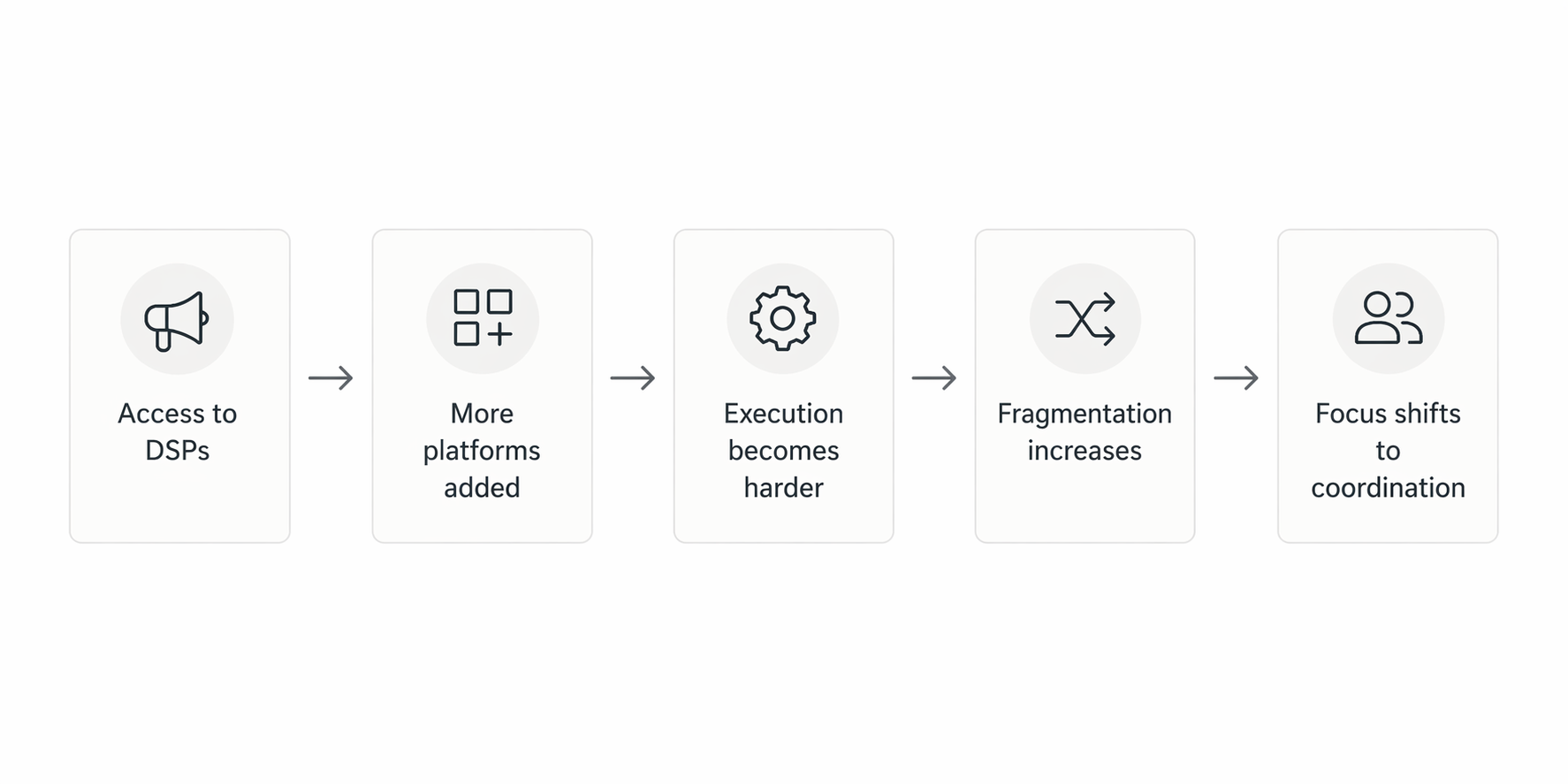
Most agencies today run campaigns across multiple DSPs. It usually starts with a clear need. One platform offers better access to CTV advertising. Another is required for specific inventory or audience data. Over time, more platforms get added to fill different gaps.
The strategy makes sense. Where things start to break down is in execution.
Campaigns get split across platforms. Budgets are handled separately. Reporting lives in different dashboards. Even small changes take longer because they have to be repeated in multiple places.
What looks like a stronger setup on paper quickly becomes harder to manage in practice.
What managing multiple DSPs actually looks like in practice
To serve different purposes and audiences, campaigns are often split across two or three platforms, each with slightly different setups. Even when the strategy is aligned, execution varies across DSPs. Audience targeting gets set up differently on each platform. Budgets are paced independently, without a shared view of total spend. Frequency control becomes fragmented, as each DSP measures exposure in isolation.
Reporting is where the gap becomes more obvious. Performance data remains distributed across DSPs, so teams have to pull and combine it to understand overall results. By the time a complete view is available, decisions are already delayed. Instead of focusing on optimization, teams end up spending time keeping systems in sync.
Why complexity increases as campaigns scale
The challenge isn’t just using multiple DSPs. It’s usually what happens as you scale them.
Each new campaign adds another layer of coordination. More platforms mean more duplication, more manual work, and more chances for things to fall out of sync.
Even simple updates like budget changes or audience refinements have to be repeated across platforms.
Over time, this creates a disconnect between programmatic strategy and execution.
Agencies know what they want to do. But getting it done consistently across DSPs becomes harder with every added layer.
Why simplifying the stack doesn’t fully solve the problem
A common response is to reduce the number of DSPs or standardize workflows.
That can help, but only to a point. Cutting down platforms can limit access to valuable inventory and data. Standardizing processes improves consistency, but it doesn’t remove the need to operate across separate systems.
The core issue remains. You’re still managing platforms that weren’t designed to work together.
What actually reduces complexity
Managing multiple DSPs becomes easier when campaign setup, targeting, and budget decisions don’t have to be recreated in each platform.
Instead of building the same audience targeting in multiple DSPs, adjusting budgets separately in each platform or pulling reports from different dashboards, the focus should be on reducing duplication across execution.
But reducing repetition alone isn’t enough. The bigger shift is moving away from treating each DSP as a completely separate system.
When campaigns, audiences, and performance are approached with a more unified view, teams can operate with greater clarity instead of constantly managing platform-level differences.
That shift from repeated execution to a more connected way of working — is what actually reduces complexity.
What a More Unified DSP Setup Looks Like
The complexity of managing multiple DSPs is driven by how they’re managed. Instead of treating each DSP as a separate environment, a more efficient setup brings them closer together into a single workflow.
Campaigns are planned once, then executed across platforms without needing to rebuild everything from scratch.
-Audiences don’t have to be redefined in every DSP.
-Budget decisions don’t happen in isolation.
-Performance isn’t locked inside individual dashboards.
Everything becomes easier to work with because it’s more connected.
This kind of approach allows teams to operate across multiple DSPs without constantly switching between them. Campaigns can be adjusted with a clearer view of how they’re performing as a whole, not just within one platform at a time.
This is where platforms like Vizibl are starting to play a role, giving agencies a way to access and manage multiple DSPs through a more unified system. Not by replacing them but by making them easier to work with together.
What agencies should focus on going forward
Using multiple DSPs is already part of programmatic advertising. What changes over time is how difficult they become to coordinate across DSPs.
This is why agencies are now asking a different set of questions
How do agencies manage multiple DSPs efficiently?
By reducing duplication and finding ways to plan, execute, and measure campaigns across DSPs without treating each platform as a completely separate workflow.
Why does using multiple DSPs feel complex?
Because each DSP operates independently, which leads to repeated work, fragmented reporting, and inconsistent campaign management.
Is it better to use fewer DSPs?
Not always. Fewer platforms can reduce operational effort, but it can also limit access to inventory, data, and performance opportunities.