Advertisers have access to an enormous amount of data. From impressions and click-through rates to audience engagement, conversions, and revenue attribution, marketers can measure almost every stage of the customer journey. Yet despite having more visibility than ever before, many agencies and marketing teams still face a familiar challenge:
A campaign performs well, but marketing leaders, clients, and business decision-makers aren’t convinced it delivered value.
The issue is rarely a lack of data. More often, it’s a lack of connection between campaign performance and business outcomes.
Many campaign reports do an excellent job of explaining what happened. They show how efficiently media was bought, how audiences engaged, and how delivery metrics improved over time.
What they often fail to explain is why those improvements mattered to the business.
As a result, campaign reviews often become discussions about campaign metrics instead of business impact.
The Growing Challenge of Marketing Reporting
The modern advertising ecosystem is significantly more complex than it was even a few years ago.
A single programmatic campaign may run across multiple channels, devices, inventory sources, audience segments, and creative variations. Each platform generates its own set of metrics, dashboards, and reporting views.
This level of visibility is valuable, but it also creates a new problem.
When advertisers have access to hundreds of data points, identifying the metrics that actually matter becomes increasingly difficult.
In many cases, reports become overloaded with information. Stakeholders are presented with dozens of KPIs, but they’re left to figure out for themselves what those metrics mean for the business.
This is where marketing reporting often breaks down. The goal of reporting is not to showcase data. The goal is to create clarity.
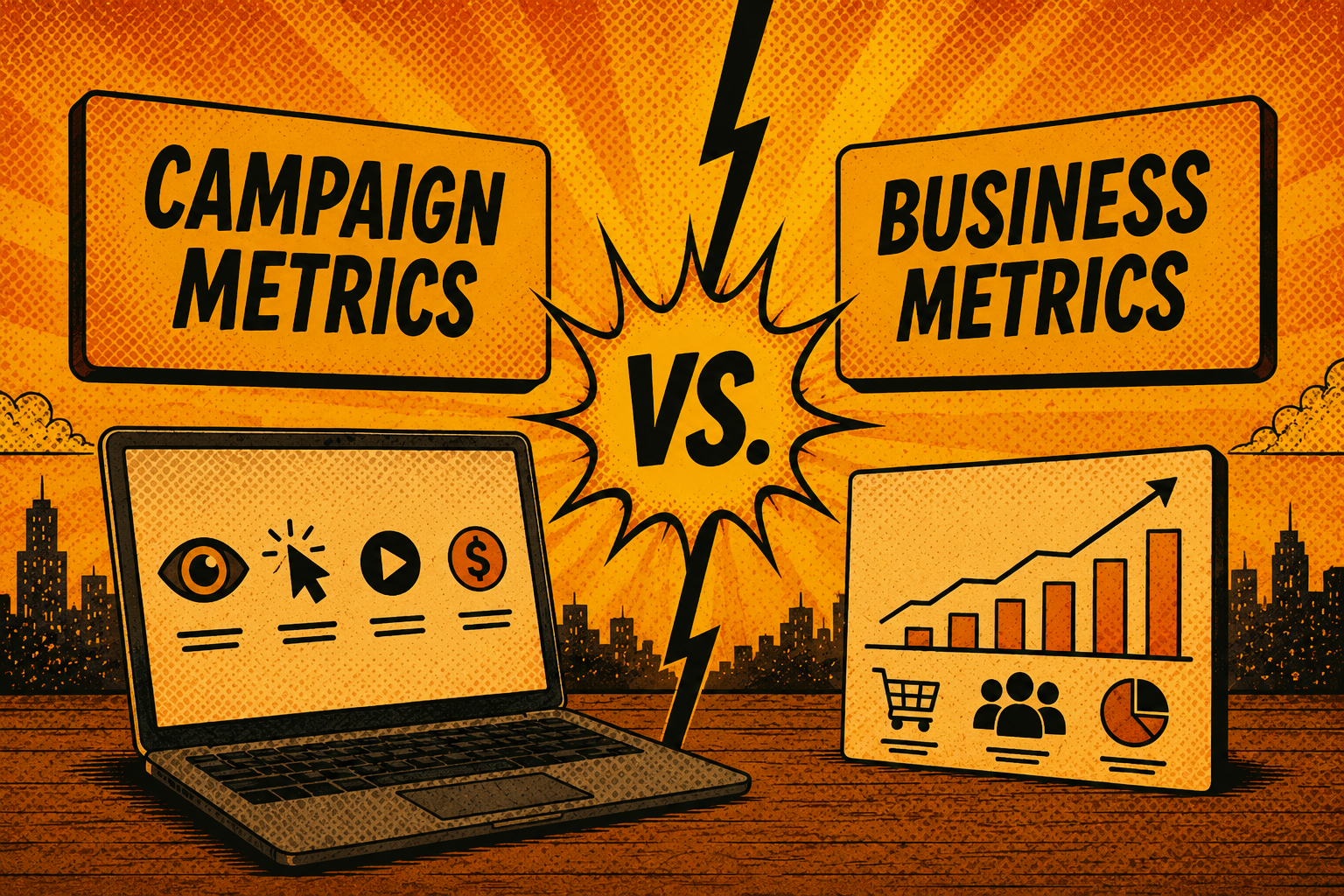
Campaign Metrics vs. Business Metrics: Understanding the Reporting Hierarchy
One of the biggest reasons campaign reviews become difficult is that different people are looking for different answers.
A media buyer wants to know whether the campaign was delivered efficiently. A marketing manager is usually focused on lead quality, engagement, and conversions. Executives and business decision-makers, on the other hand, want to understand whether the campaign contributed to revenue, pipeline growth, or overall business performance.
None of these perspectives are wrong. They’re simply answering different questions.
The challenge is that campaign reports often present every metric with equal importance, even though not every audience reads them the same way.
A more effective way to think about reporting is as a hierarchy instead of a long list of KPIs.
Business Outcomes
↑
Customer Outcomes
↑
Campaign Performance
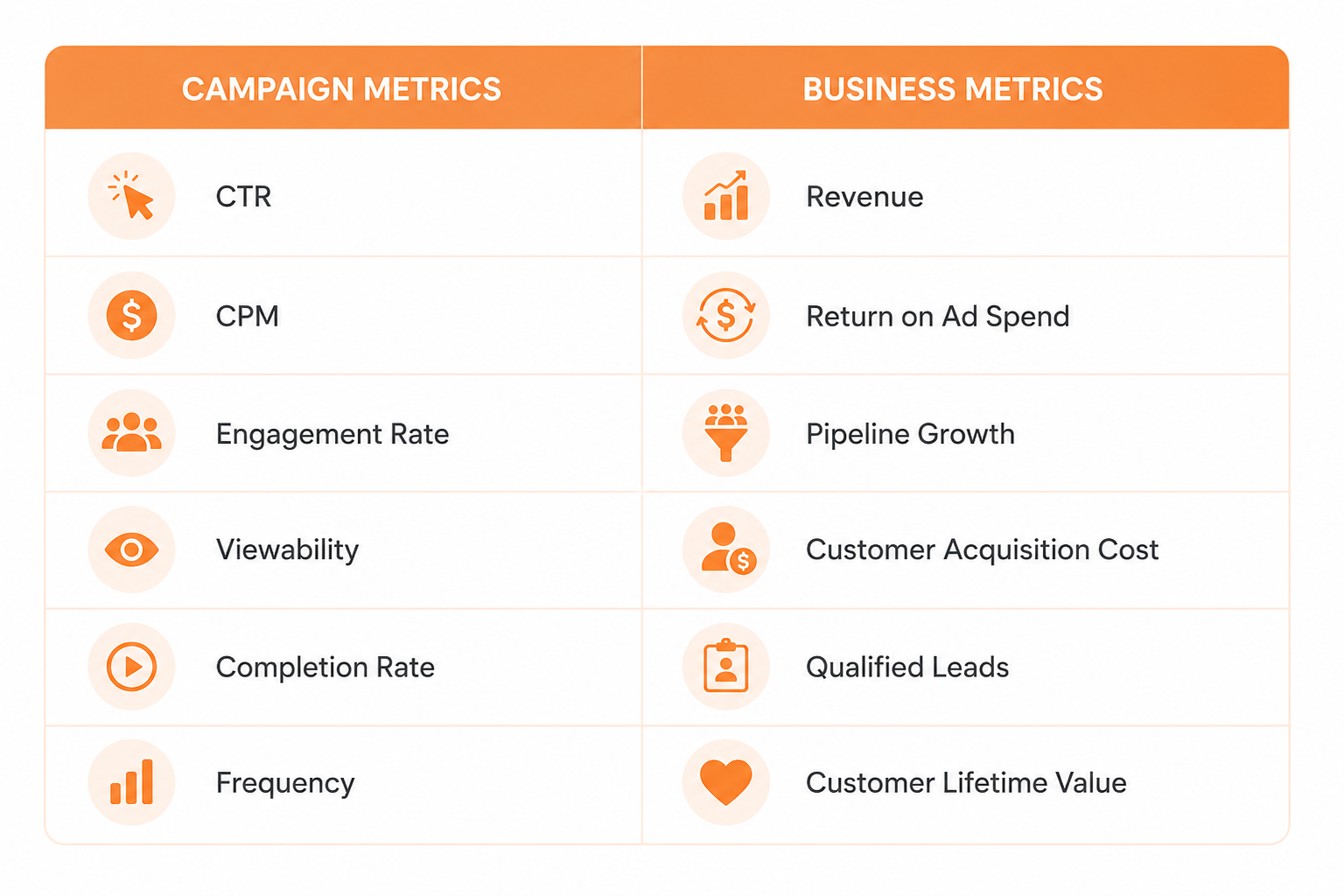
At the foundation are campaign performance metrics such as impressions, CPM, CTR, viewability, and frequency. These explain how efficiently media was delivered.
The next layer focuses on customer outcomes like qualified leads, engagement rate, customer acquisition cost, and conversions. These help explain how audiences responded to the campaign.
At the top are the business outcomes that matter most to executives and business leaders: revenue, return on ad spend (ROAS), pipeline contribution, and customer lifetime value.
Campaign metrics explain how a campaign performed.
Business metrics explain why that performance mattered.
The strongest campaign reports don’t stop at delivery metrics. They connect all three layers to show how campaign performance contributed to meaningful business outcomes.
Why More Metrics Don’t Always Lead to Better Decisions
A common assumption in marketing is that more data automatically leads to better insights.
In reality, more data often creates more noise.
Consider a report that contains dozens of metrics across multiple channels, platforms, and audience segments.
-CTR improved.
-CPMs decreased.
-Viewability increased.
-Reach expanded.
While all of these metrics may indicate positive campaign performance, they don’t automatically answer the questions marketing leaders and clients care about most.
- Did lead quality improve?
- Did customer acquisition become more efficient?
- Did the campaign contribute to pipeline growth?
- Did advertising generate a measurable return?
Without context, metrics become disconnected from outcomes. And when metrics become disconnected from outcomes, reporting loses its ability to influence business decisions.
The Hidden Cost of Reporting Activity Instead of Impact
One of the most common reporting mistakes is prioritising campaign activity over business impact. Activity metrics are easier to access, easier to explain, and often easier to improve. Impact metrics are harder to measure because they typically involve multiple touchpoints, longer sales cycles, and collaboration across teams.
As a result, reports often celebrate improvements in engagement while overlooking whether those improvements contributed to meaningful business results.
For example, a campaign may generate significantly more clicks than a previous campaign.
That sounds positive. But if lead volume, conversion quality, and revenue remain unchanged, stakeholders will naturally question the value of those additional clicks.
This doesn’t mean campaign metrics are unimportant. It simply means they need context.
A higher CTR is valuable if it contributes to better business outcomes.
A lower CPM is valuable if it improves efficiency without compromising performance.
Metrics become meaningful when they are tied to results.
A Programmatic Advertising Example
This challenge becomes particularly apparent in programmatic advertising. Imagine a campaign targeting decision-makers across CTV, display, and native inventory.
The media team successfully improves delivery efficiency throughout the campaign. CPMs decline, audience engagement increases, and the campaign reaches more qualified users than initially projected.
From a campaign management perspective, those are positive developments.
However, when business leaders or clients review campaign performance…
They’re more likely to ask:
- Did we generate more qualified opportunities?
- Did the pipeline increase?
- Did the campaign influence revenue?
If reporting focuses exclusively on campaign delivery metrics, it becomes difficult to answer those questions. The campaign may have performed exceptionally well, but the report fails to demonstrate its business value.
This is one of the biggest reasons advertisers struggle to prove marketing ROI despite having access to extensive performance data.
Why Proving Impact Isn’t Always Straightforward
Of course, connecting campaign activity directly to revenue isn’t always simple.
Modern customer journeys rarely follow a straight line. A prospect may see a Connected TV ad, engage with a display campaign days later, visit the website organically, download a resource through LinkedIn, and only convert weeks afterwards.
In these situations, no single campaign deserves all the credit.
That’s why leading advertisers increasingly rely on a combination of measurement approaches, including:
- Multi-touch attribution, which distributes credit across multiple interactions.
- Marketing Mix Modelling (MMM), which estimates the contribution of different channels over time.
- Incrementality testing, which measures the lift generated by advertising compared to doing nothing.
The goal isn’t perfect attribution because perfect attribution rarely exists.
The goal is building enough evidence to understand how marketing contributes to business growth and to make better investment decisions.
This distinction matters.
Reporting should help decision-makers make smarter decisions and not create the illusion of perfect measurement.
The Shift Advertisers Need to Make
Many reporting frameworks follow the same pattern. They start with campaign activity and eventually work toward business outcomes. The problem is that stakeholders care about outcomes first.
A marketing leader reviewing campaign performance wants to understand whether business goals were achieved before diving into delivery metrics.
This requires a simple but important shift.
Instead of building reports like this:
Campaign Activity → Engagement → Conversions → Business Impact
Advertisers should think about reporting like this:
Business Impact → Conversions → Campaign Activity
This approach changes the role of campaign metrics. Rather than acting as the headline, they become supporting evidence that explains how outcomes were achieved.
The result is reporting that is easier to understand, easier to defend, and more useful for decision-making.
Building Reports That Stakeholders Actually Care About
Effective campaign reporting starts with a simple question: What business objective was this campaign designed to achieve?
Every metric included in the report should help answer that question. If the objective was lead generation, the report should prioritise metrics such as lead volume, lead quality, and cost per lead.
If the objective was revenue growth, metrics such as return on ad spend, customer acquisition cost, and revenue contribution should take center stage.
Campaign metrics still play an important role, but their purpose should be to explain performance rather than define success.
The most effective reports don’t overwhelm decision-makers with data.
They connect campaign performance to business outcomes and provide the context needed to understand why results occurred.
Why Interpretation Matters More Than More Data
As media buying continues to evolve, the ability to collect data will become less of a competitive advantage. Almost every advertiser has access to dashboards, analytics platforms, and measurement tools.
The real differentiator will be interpretation.
The agencies and marketing teams that stand out won’t necessarily be the ones tracking the most metrics. They will be the ones that can clearly demonstrate how campaign activity influences business performance.
In a landscape where stakeholders are under increasing pressure to justify budgets and prove ROI, that ability becomes incredibly valuable.
Closing the Gap Between Performance and Impact
Campaign reports fail to show marketing impact not because advertisers lack data, but because they often struggle to connect campaign performance to business outcomes.
The solution isn’t adding more metrics to dashboards.
It’s building reporting frameworks that start with business objectives, prioritize outcomes, and use campaign metrics to explain how those outcomes were achieved.
In today’s advertising landscape, business leaders, clients, and marketing teams don’t need more data.
They need a clearer understanding of what that data means for the business.
And the marketers who can provide that clarity will be far better positioned to prove ROI, earn stakeholder trust, and drive smarter advertising decisions.