Digital advertising has become increasingly sophisticated. Advertisers have access to demographic data, interest-based segments, browsing behaviour, and contextual signals. Yet one challenge continues to persist: identifying audiences that are genuinely likely to take action.
These signals often reveal what consumers may be interested in, but they don’t always indicate what they intend to do next.
This is why advertisers are increasingly turning to hyperlocal advertising and location intelligence to build campaigns around real-world behaviour.
As demand for more accurate audience targeting grows, advertisers are also looking for platforms that simplify campaign creation, media planning, reporting, and optimisation. This shift is driving a new era of AI-powered advertising, where location intelligence and automation work together to help marketers launch smarter campaigns, faster.
The result is a more intuitive approach to campaign management that helps advertisers move from audience discovery to campaign activation with greater speed, precision, and confidence.
TL;DR
- Hyperlocal targeting helps advertisers reach high-intent audiences using real-world location data instead of relying solely on demographics or browsing behaviour.
- Location intelligence reveals stronger purchase intent through consumer movement patterns, store visits, and points of interest (POIs).
- Combining geo-prospecting and geo-retargeting allows brands to engage consumers throughout different stages of the purchase journey.
- AI-powered campaign management, media planning, and reporting are helping advertisers simplify workflows and make faster, more informed decisions.
- Modern hyperlocal advertising platforms bring together targeting, planning, reporting, and optimisation to help advertisers launch and manage campaigns more efficiently.
What is Hyperlocal Targeting?
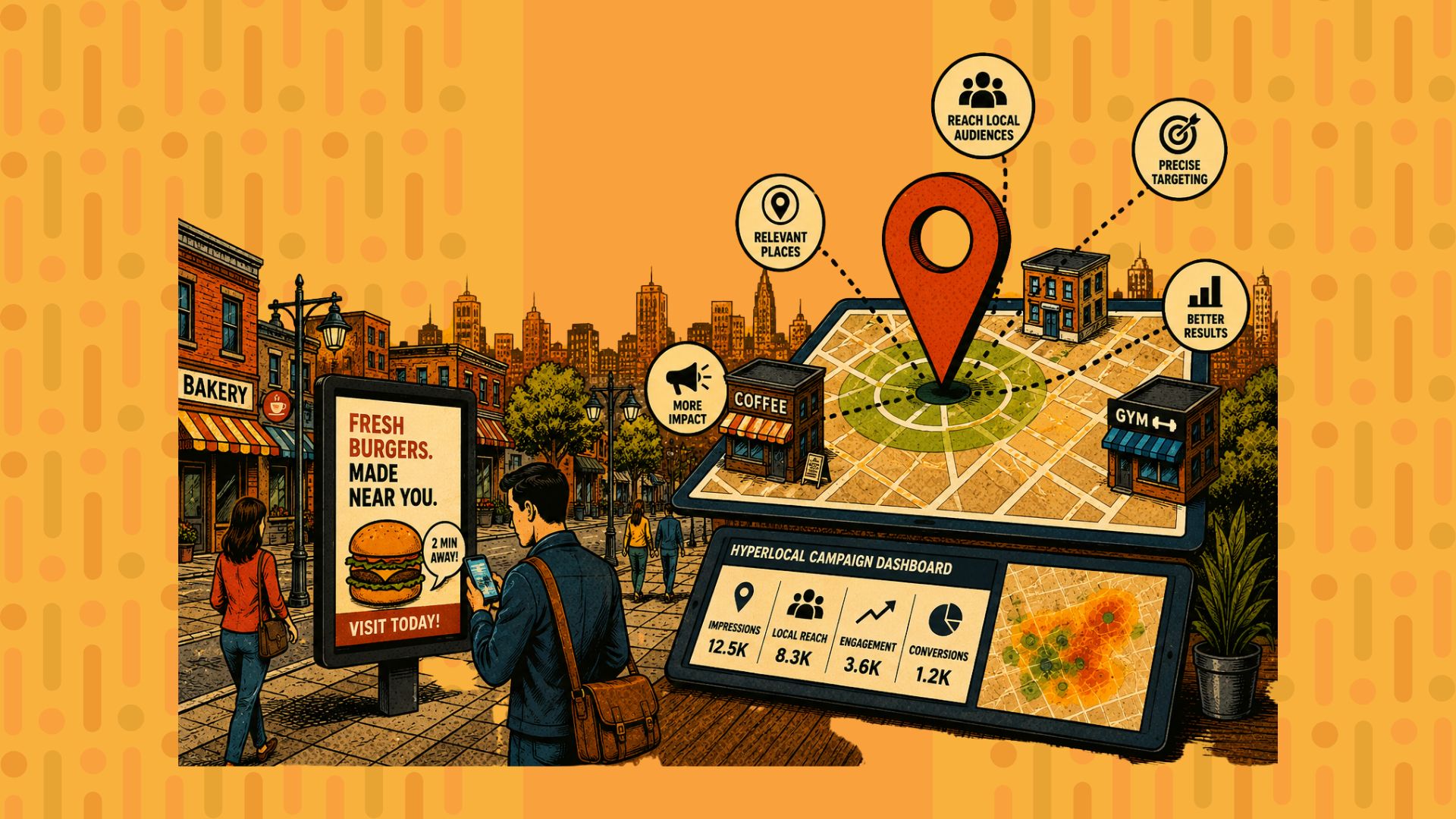
Hyperlocal targeting is a location-based advertising strategy that helps brands reach audiences based on where they are, where they’ve been, or how they move through the physical world.
Unlike traditional geo-targeting that focuses on broad geographic areas such as cities or ZIP codes, hyperlocal targeting uses mobile location data, geofencing, POI (Point of Interest) targeting, radius targeting, and location intelligence to engage consumers within highly specific locations.
For example, a quick-service restaurant (QSR) launching a new outlet can target people within a two-kilometre radius during lunch hours. A retail brand can engage shoppers who recently visited a competing store, while an automotive dealership can reconnect with consumers who have visited multiple dealerships over the past month.
Rather than relying on assumptions about who consumers might be, hyperlocal targeting allows advertisers to build audiences around actual movement patterns and real-world behaviour.
As consumer journeys become increasingly omnichannel, combining online signals with offline location data enables brands to create more relevant advertising experiences and improve visit conversions.
Why Is Traditional Audience Targeting Losing Accuracy?
Traditional audience targeting is becoming less accurate because it often relies on inferred interests instead of real-world behaviour.
For years, advertisers have built campaigns around demographics, browsing behaviour, cookies, contextual targeting, and interest-based audience segmentation. While these methods continue to play an important role, they don’t always indicate whether someone is ready to act.
Someone reading restaurant reviews isn’t necessarily looking for somewhere to eat today. A consumer researching electric vehicles may still be months away from making a purchase. Interest often reflects curiosity—not intent.
At the same time, advertisers continue to navigate challenges such as cookie deprecation, fragmented customer journeys, stricter privacy regulations, and reduced visibility into offline behaviour.
In enterprise campaigns, we often see advertisers relying heavily on demographic and behavioural assumptions even when stronger location signals are available.
As a result, many campaigns end up reaching audiences who appear relevant on paper but have little immediate purchase intent.
This is where location intelligence is changing the conversation.
How Does Location Intelligence Reveal Purchase Intent?
Location intelligence reveals purchase intent by analysing where consumers go, how often they visit specific locations, and the behaviours that indicate they’re moving closer to making a purchase.
Think about the difference between someone who searches online for the “best burgers near me” and someone who visits three different burger chains over the course of a week.
Or consider a shopper who reads reviews about running shoes versus someone who spends time inside multiple sporting goods stores over several weekends.
One reflects interest. The other demonstrates intent.
For many retail advertisers, these real-world behaviours provide significantly stronger signals than online browsing activity alone.
Location intelligence helps advertisers uncover three powerful behavioural signals:
Mapped Behaviour
Understanding where consumers spend time, which stores they visit, and how frequently they return helps advertisers identify meaningful audience patterns that traditional digital signals often miss.
Intent Signals
Visiting competitor locations, attending industry events, exploring shopping centres, or spending time at specific points of interest (POIs) often provides stronger indications of purchase intent than browsing behaviour alone.
Lifestyle Signals
Recurring movement patterns reveal routines, preferences, and affinities, helping advertisers build more relevant audience segments and personalise messaging more effectively.
Many retail advertisers discover that combining these signals leads to stronger audience segmentation, higher visit conversions, and more efficient media spend.
This growing reliance on location intelligence is exactly why platforms such as Vizibl Hyperlocal enable advertisers to build audience strategies around real-world consumer behaviour rather than broad demographic assumptions.
Geo-Prospecting vs. Geo-Retargeting: What’s the Difference?
Geo-prospecting helps advertisers reach consumers based on where they are today, while geo-retargeting reconnects with audiences based on places they’ve previously visited.
Although both approaches use location intelligence, they serve different objectives within the customer journey.
Geo-prospecting is ideal for reaching people who are currently within or around a specific location.
For example, a coffee chain could target office workers within a one-kilometre radius during morning commuting hours, while a QSR brand could engage nearby audiences with lunchtime offers using proximity marketing.
Geo-retargeting focuses on consumers who have already visited a relevant location.
Imagine a fashion retailer reconnecting with shoppers who recently visited a competitor’s flagship store, or a travel brand targeting consumers who spent time at an airport during the past 30 days. Many advertisers find that geo-retargeting performs especially well for nurturing high-intent audiences because it builds on verified real-world behaviour rather than inferred interests.
The strongest hyperlocal campaigns don’t rely on just one approach.
By combining geo-prospecting and geo-retargeting, advertisers can engage audiences both during moments of immediate relevance and throughout the broader decision-making journey.
Platforms such as Vizibl Hyperlocal bring both geo-prospecting and geo-retargeting together, allowing advertisers to activate both strategies from a single campaign management experience.
Why Is AI Changing Hyperlocal Campaign Management?
AI is changing hyperlocal campaign management by simplifying campaign setup, reducing manual effort, and helping advertisers launch campaigns more efficiently.
One of the biggest frustrations advertisers face today has little to do with targeting.
It’s campaign creation. Despite advances in advertising technology, launching a campaign often means navigating multiple setup screens, configuring targeting parameters, selecting inventory, defining budgets, and reviewing numerous settings before a campaign can go live.
While these workflows provide flexibility, they also introduce friction.
As AI continues to reshape digital advertising, advertisers increasingly expect campaign creation to feel less like filling out forms and more like briefing a colleague.
Instead of manually configuring every campaign setting, marketers want to describe their audience, geography, campaign objectives, and budget—and let technology help translate those requirements into campaign setup.
This conversational approach is reflected in Vizibl Hyperlocal’s AI-powered Campaign Assistant, which guides advertisers through campaign creation using a more intuitive, conversational experience rather than traditional form-based workflows.
Many enterprise advertisers are already embracing this shift because it reduces operational complexity and allows campaign teams to focus more on audience strategy and campaign performance than repetitive configuration tasks.
Ultimately, AI is helping remove unnecessary complexity so they can spend more time making strategic decisions and less time managing campaign setup.
How Does Smarter Media Planning Improve Campaign Performance?
Smarter media planning improves campaign performance by helping advertisers validate audiences, budgets, and targeting strategies before campaigns go live.
Many campaign decisions are made long before the first impression is served. Audience selection, budget allocation, targeting strategy, expected reach, and channel mix all influence campaign outcomes before launch.
Yet many advertisers still make these decisions with limited visibility. As a result, optimisation often begins only after budgets have already been committed.
A more effective approach is to evaluate campaign assumptions before activation.
Media planning enables advertisers to review audience opportunities, forecast reach, align budgets with campaign objectives, and secure stakeholder approval before launching.
When scaling campaigns across hundreds of retail locations or franchise outlets, even small planning improvements can significantly reduce wasted spend and improve campaign efficiency.
Increasingly, advertisers are looking for platforms that integrate media planning directly into campaign workflows rather than treating it as a separate exercise.
Vizibl Hyperlocal supports this approach by allowing advertisers to create and review a media plan before launching a campaign, helping teams make more informed decisions before activation.
What Should Modern Hyperlocal Campaign Reporting Look Like?
Modern hyperlocal campaign reporting should go beyond metrics to provide clear, actionable insights that help advertisers optimise campaigns faster.
As campaigns become more sophisticated, reporting has become far more than a post-campaign exercise.
Advertisers today are expected to understand performance across audiences, locations, devices, creatives, and channels while demonstrating measurable business outcomes such as store visits, footfall attribution, and visit conversions.
The challenge isn’t a lack of data. It’s making sense of it.
Traditional spreadsheets and static reports often make it difficult to identify trends quickly or communicate campaign performance effectively to clients and stakeholders.
Visual reporting experiences help solve this problem. Interactive dashboards, intuitive charts, and location-based performance visualisations enable advertisers to understand campaign performance faster and uncover optimisation opportunities with greater confidence.
Our teams have consistently found that advertisers identify performance trends much faster when campaign data is presented visually rather than through rows of numbers alone.
This approach is reflected in Vizibl Hyperlocal’s visual dashboards, making it easier to monitor campaign performance, compare audience segments, and evaluate results through a more intuitive reporting experience.
How Can AI Help Advertisers Understand Campaign Performance?
AI helps advertisers understand campaign performance by identifying patterns, explaining results, and surfacing optimisation opportunities automatically.
Campaign reports tell marketers what happened. AI helps explain why it happened.
This distinction is becoming increasingly valuable as campaign complexity grows. Marketing teams often spend hours analysing reports, identifying anomalies, comparing audience performance, and searching for optimisation opportunities.
AI can significantly reduce this effort by highlighting meaningful observations automatically.
Instead of manually interpreting dozens of metrics, advertisers can focus on making better decisions. Rather than functioning as another reporting layer, AI is transforming reporting into a proactive decision-making tool that helps marketers react faster and optimise campaigns with greater confidence.
As AI becomes increasingly integrated into campaign management, advertisers are beginning to expect insights and not just dashboards.
To support faster analysis, Vizibl Hyperlocal includes AI-powered reporting insights that help advertisers better understand campaign performance and identify optimisation opportunities.
How Can Agencies and Brands Scale Campaign Reporting?
Campaign reporting becomes easier to scale when report creation, scheduling, and sharing are automated.
Reporting remains one of the most time-consuming aspects of campaign management.
Whether preparing weekly client updates, sharing campaign summaries with leadership, or reporting across multiple locations, marketers often spend hours exporting data, formatting presentations, and building reports manually.
As campaign volumes increase, these repetitive tasks become difficult to scale.
Automation helps remove much of this operational burden.
Advertisers increasingly look for reporting workflows that generate presentation-ready reports, schedule recurring updates, and deliver consistent reporting without manual intervention.
Many agencies managing campaigns across multiple clients find that automating reporting not only saves time but also improves consistency and reduces the risk of human error.
Rather than spending valuable hours preparing reports, marketing teams can focus on campaign optimisation and strategic planning.
Vizibl Hyperlocal also includes professionally formatted PDF reports and enhanced report scheduling, making it easier to share campaign updates with clients and stakeholders while reducing manual reporting effort.
Which Advertising Pricing Model Best Supports Different Campaign Goals?
The best advertising pricing model depends on whether your objective is awareness, engagement, or performance.
No single buying model works for every campaign. Brand awareness initiatives often prioritise reach and predictable delivery, while performance campaigns focus on engagement, website visits, or other measurable outcomes.
As campaign objectives become more diverse, advertisers increasingly need flexibility in how media is purchased.
For campaigns focused on broad reach and controlled media spend, CPM-based buying models often provide greater predictability.
Performance-focused campaigns may benefit from CPC models that align spend more closely with user engagement.
Meanwhile, dynamic pricing models can help advertisers optimise efficiency in real time by responding to changes in inventory availability and audience demand.
The goal isn’t to identify one universally better pricing model.
It’s to choose the buying approach that best aligns with campaign objectives, budget strategy, and measurement goals.
Recognising that advertisers have different objectives, Vizibl Hyperlocal supports Fixed CPM, Fixed CPC, and Dynamic CPM, giving teams the flexibility to tailor buying strategies to each campaign.
What Should Advertisers Look for in a Modern Hyperlocal Advertising Platform?
The best hyperlocal advertising platforms combine location intelligence, AI, campaign planning, reporting, and optimisation into a single workflow.
Hyperlocal targeting has evolved far beyond simple geofencing.
Today’s advertisers need platforms that do more than identify audiences near a location.
They need solutions that help them discover high-intent audiences, simplify campaign creation, improve planning, surface actionable insights, and measure business outcomes more effectively.
The most capable platforms typically combine:
- Advanced geo-prospecting and geo-retargeting
- AI-powered campaign creation
- Integrated media planning
- Flexible buying models
- Rich visual dashboards
- AI-powered reporting insights
- Automated report scheduling
- Professional PDF reporting
As advertiser expectations continue to evolve, the industry is moving away from disconnected tools for targeting, planning, reporting, and optimisation. Instead, marketers are looking for unified campaign management experiences that simplify workflows while improving efficiency.
Vizibl Hyperlocal is designed to bring together location intelligence, geo-prospecting, geo-retargeting, AI-powered campaign creation, media planning, flexible buying models, intelligent reporting, and automated workflows into a single platform experience.
The goal is to help advertisers spend less time navigating technology and more time turning real-world consumer behaviour into measurable business outcomes.