An Account Based Marketing (ABM) strategy can tell you exactly which accounts matter. It doesn’t automatically tell you how to reach the people within those accounts, what they should see, or how to keep engaging them throughout a long B2B ABM journey.
That’s where programmatic advertising becomes useful.
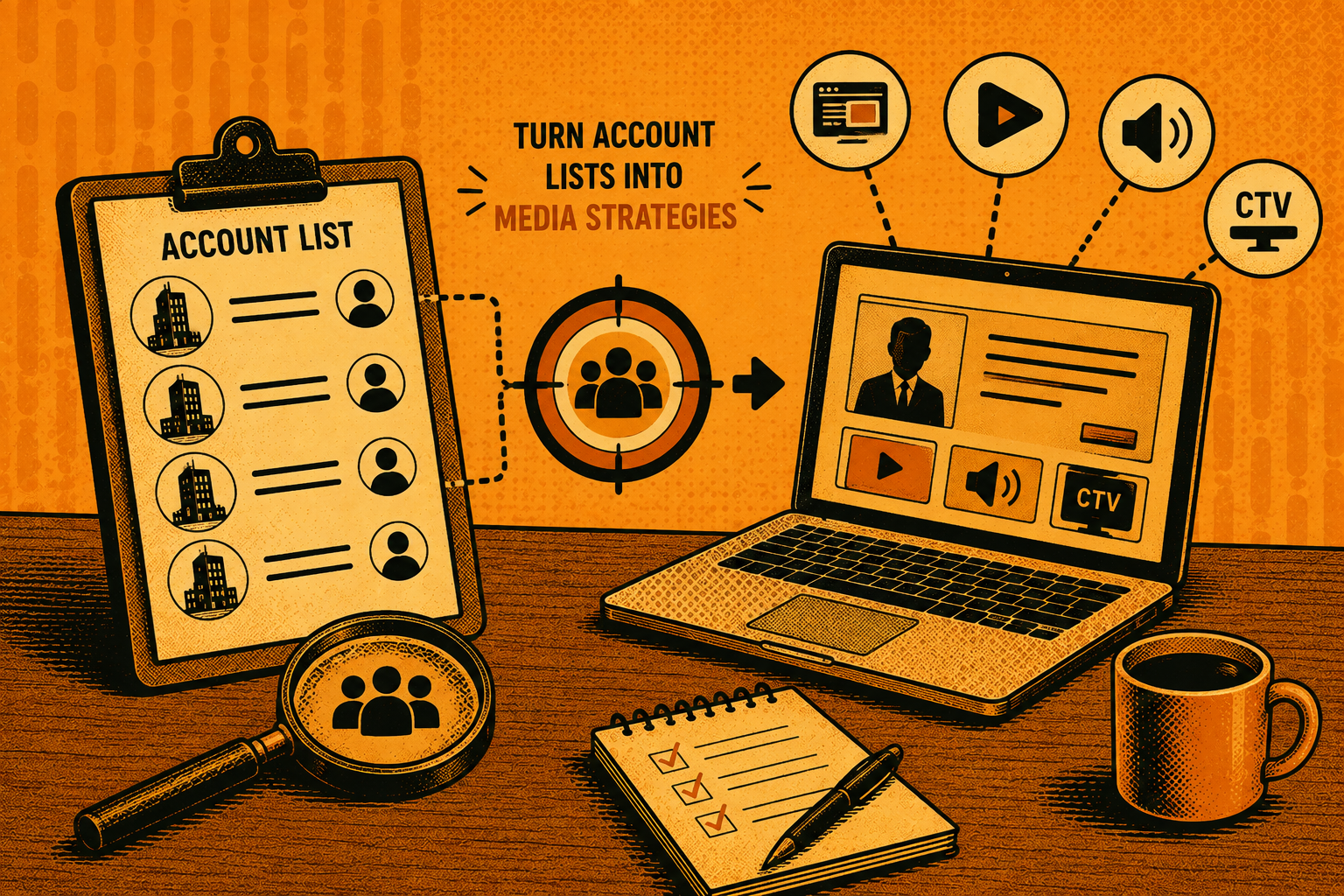
For agencies, programmatic can turn an account strategy into an active media strategy combining audience signals, contextual and behavioural data, creative sequencing and cross-channel activation across display, video, audio and CTV.
ABM determines who matters. Programmatic helps determine how to reach them.
Used together, they can give agencies a more scalable way to build awareness, nurture engagement and measure progression among priority accounts.
TL;DR
- ABM tells you which accounts matter; programmatic helps activate that strategy across digital media.
- Start with priority accounts and map the people, roles and audience signals you need to reach.
- Use prospecting, retargeting and sequential messaging across display, video, audio and CTV to support different stages of the buying journey.
- Match creative to audience, account segment and buying stage rather than showing everyone the same ad.
- Measure more than impressions and clicks: look at priority-account engagement, meaningful site activity, leads, opportunities and pipeline.
- For agencies, a multi-DSP approach can provide more flexibility around audiences, inventory and campaign capabilities.
How Does Programmatic Fit Into a B2B ABM Strategy?
Programmatic advertising adds the media activation layer to an Account Based Marketing strategy. But it works best when it follows the account strategy rather than operating separately from it.
The simplest way to think about the relationship is:
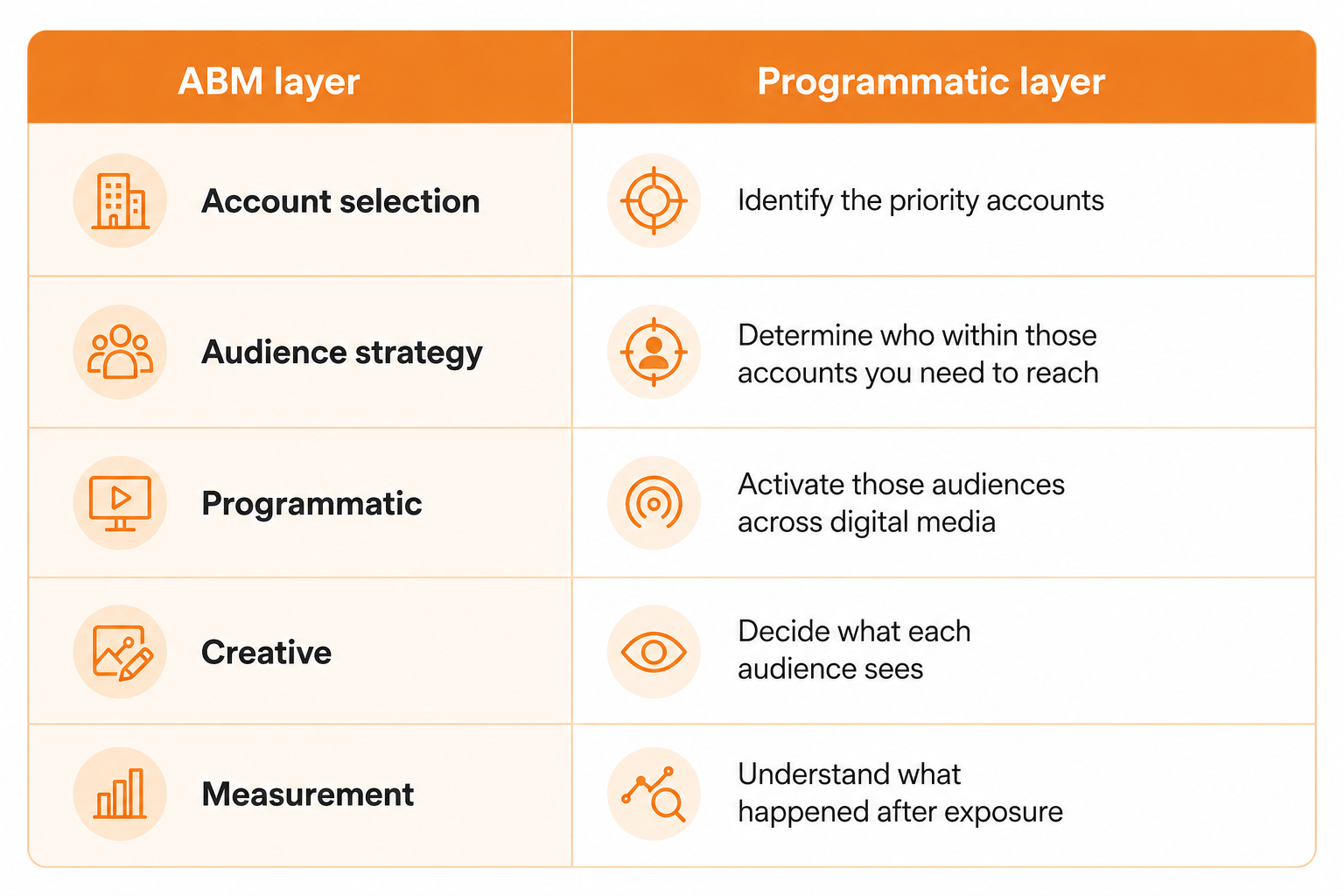
- ABM Starts With Account Selection
ABM starts by identifying the companies that matter most to the business. Instead of treating every company as a potential customer, agencies can build campaigns around a defined set of priority accounts based on factors such as business value, industry, company size, geography or sales priorities.
The account list provides the strategic foundation for the campaign. The next question is how to reach the people within those organisations.
2. Audience Strategy Defines Who Within Those Accounts Matters
An account list doesn’t automatically tell you which individuals to reach.
A B2B purchase may involve several people, from marketing and technology leaders to procurement teams and senior executives. Each may have different responsibilities, priorities and levels of influence.
Agencies therefore need to translate the account strategy into an audience strategy using the signals available to the campaign. Depending on the setup, these could include first-party data, third-party audience segments, behavioural signals, contextual signals and lookalike audiences.
The exact approach depends on the data, identity solutions and inventory available. The important point is that account selection defines where to focus, while audience strategy helps determine who to reach.
3. Programmatic Activates the Strategy Across Media
Once the accounts and relevant audiences are defined, programmatic advertising provides the media activation layer.
Agencies can use programmatic to reach relevant audiences across display, video, CTV and audio, depending on audience availability, campaign objectives and inventory.
This gives agencies a way to support both account-based prospecting and retargeting rather than relying on a single interaction or channel.
For example, an agency running an ABM campaign for a cybersecurity client may have a list of priority companies and a set of roles involved in technology purchasing. The agency can use available audience and contextual signals to build a media strategy designed to reach relevant people associated with those accounts.
Programmatic therefore doesn’t replace the ABM strategy. It helps put that strategy into market at scale.
4. Creative Determines What Those Audiences See
Reaching the right audience is only part of the equation. The message also needs to reflect what that audience is likely to care about.
A CFO and a technical lead at the same company may be involved in the same purchase but have very different priorities. One may care about business impact and cost, while the other may focus on integration, security or technical performance.
Agencies can therefore adapt creative based on meaningful differences such as audience role, industry, account segment or stage of the buying journey.
Early-stage audiences might see messaging focused on a business problem, while audiences that have already interacted with the brand could receive more specific product messaging, customer proof points or a relevant next step.
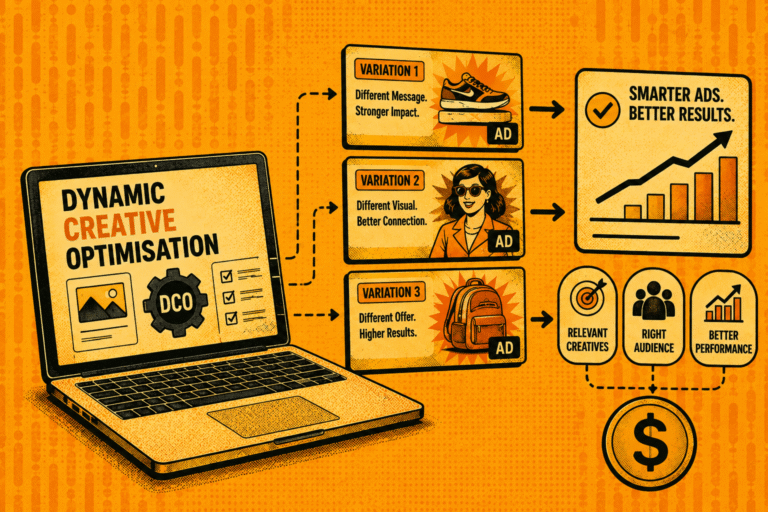
For campaigns that require multiple variations, Dynamic Creative Optimization (DCO) can also help agencies manage different combinations of creative elements based on predefined campaign signals and rules.
5. Measurement Shows What Happened
The final layer is understanding whether the campaign is actually moving priority audiences forward.
Impressions, CTR, CPM and CPC can help agencies evaluate media delivery and efficiency, but they don’t tell the full ABM story.
Agencies should also consider metrics such as:
- Engagement from priority audiences
- Website visits and meaningful site activity
- Content downloads and other high-value actions
- Engagement trends over time
- Qualified leads and opportunities
- Progression from marketing engagement to sales activity
- Pipeline contribution, where it can be reliably measured
This creates a clearer connection between the original account strategy and the media activity supporting it.
The overall process is therefore:
ABM identifies the accounts → audience strategy identifies who within them to reach → programmatic activates the media → creative determines what they see → measurement shows what happened.
From there, agencies can use different programmatic tactics depending on where those audiences are in the buying journey.
What Are the Biggest Challenges With Programmatic B2B ABM?
Running a programmatic B2B ABM campaign involves more than uploading a list of target companies and buying impressions.
Agencies need to make sure the available audience signals are relevant, campaigns can scale without losing focus, creative remains useful throughout the buying journey, and performance can be measured against meaningful outcomes.
Here are some of the most common challenges agencies face and practical ways to address them.
1. An Account List Isn’t an Audience
The challenge: Knowing which companies a client wants to reach doesn’t necessarily tell you how to reach the right people within those businesses.
An account list needs to be translated into usable audience signals before it can become an effective programmatic campaign.
The solution: Start with the data and signals available to the campaign.
Depending on the campaign, this could include first-party data, third-party audience segments, behavioural signals, contextual targeting and lookalike audiences.
The important step is to define the audience strategy before choosing the media. An account list can inform the strategy, but it doesn’t automatically guarantee deterministic access to every individual within those companies.
2. Scaling ABM Without Making Campaign Management More Complicated
The challenge: A focused ABM strategy can become difficult to manage when an agency is working across multiple audience groups, channels, DSPs and campaign objectives.
Creating separate workflows for every variation can quickly increase operational workload.
The solution: Group audiences into meaningful segments based on factors such as industry, business value, geography, audience characteristics or campaign objective.
Agencies can then apply the appropriate targeting and creative strategy to each group rather than building an entirely separate workflow for every variation.
Multi-DSP campaigns can introduce another layer of complexity because each DSP can have its own workflow, reporting and optimisation process.
3. Making Creative Relevant to Different B2B Audiences
The challenge: A campaign can reach the right audience and still underperform if everyone sees the same generic message.
Different industries, audience segments and stages of consideration may require different reasons to engage.
The solution: Match creative to meaningful audience differences rather than creating variations simply for the sake of personalisation.
Early-stage audiences might respond to messaging around a business problem, while users who have already interacted with the brand may be ready for more specific product or solution messaging.
For campaigns that require multiple creative variations, DCO can help agencies adapt elements such as messaging, visuals and calls to action based on campaign signals.
This is particularly relevant for retargeting, where a user’s previous interaction can provide a stronger basis for determining which creative they see.
4. Maintaining Relevance Across Longer B2B Buying Cycles
The challenge: B2B purchase journeys can take considerably longer than many consumer campaigns.
Without a clear sequencing and frequency strategy, the same audience may repeatedly see the same creative without receiving anything new or useful.
The solution: Treat frequency and messaging as part of the broader campaign strategy.
Set appropriate exposure controls and adjust messaging as audiences engage.
A prospect who has only encountered the brand once may need a different message from someone who has already visited the website or interacted with previous advertising.
Frequency should also be considered alongside audience size, campaign duration, creative rotation and channel mix.
The goal is to maintain useful visibility without creating unnecessary repetition.
5. Proving That Programmatic Is Influencing Target Audiences
The challenge: Impressions, clicks and CTR can tell an agency whether media was delivered and whether users interacted with it.
They don’t necessarily show whether the campaign is reaching valuable audiences or contributing to a longer B2B buying journey.
The solution: Define account-level and business-oriented KPIs before the campaign launches.
Depending on the client’s objectives, these could include engagement from priority audiences, website activity, content interactions, conversions, qualified leads, opportunities or pipeline contribution.
Media metrics should still be monitored, but they should sit alongside metrics that help the client understand what happened after the campaign reached the intended audience.
6. Getting Enough Scale Without Broadening the Audience Too Far
The challenge: B2B ABM campaigns need to balance precision with sufficient reach.
An audience that’s too narrow may struggle to generate enough delivery, while broadening the targeting too aggressively can dilute the account-based strategy.
The solution: Start with the highest-value audiences and expand deliberately.
Agencies can combine first-party data with relevant third-party, contextual, behavioural or lookalike segments when additional reach is required.
The key is to expand based on a clear audience strategy rather than broadening targeting simply because delivery is low.
This is particularly important when working with smaller account lists. Agencies should understand the available audience and inventory options before launch and set realistic expectations for scale.
Use Programmatic to Reach Priority Accounts Before They’re in Market
Agencies can use programmatic advertising to introduce their clients to relevant audiences before those audiences are actively in-market.
A common mistake in B2B ABM is waiting for an account to show obvious buying intent before communicating with it.
B2B purchasing decisions often involve multiple interactions long before a prospect submits a form or requests a sales conversation. Building familiarity earlier can therefore be an important part of the overall strategy.
Programmatic can help agencies maintain awareness through display, video, CTV and other digital formats.
Suppose an agency is targeting 500 priority companies for a B2B software client. Rather than running a broad campaign aimed at every business in the same industry, the agency can define the audience characteristics associated with those accounts and build messaging around the problems the product solves.
The campaign might begin with broader problem-focused messaging and then introduce more specific product or solution messaging as audiences engage with the brand.
This makes programmatic ABM more than a reach tactic. It becomes part of a longer process of building familiarity with audiences that may take months to enter an active buying cycle.
Can Programmatic Advertising Help With Retargeting For B2B ABM?
Yes. Retargeting is one of the most practical ways to connect programmatic advertising with an existing B2B ABM strategy.
Once someone has visited a website, viewed a product page, downloaded content or completed another meaningful interaction, the campaign has a stronger signal than simply knowing that the person belongs to a broad audience.
That interaction can inform the next stage of the campaign.
For example, someone who has downloaded a guide could receive advertising promoting a related solution, case study or deeper piece of content rather than seeing the same introductory message again.
Someone who has visited a product page could receive creative focused on product benefits, proof points or a relevant next step.
This approach is particularly useful for B2B advertisers because the buying journey is rarely linear. Prospects may engage with content, disappear for several weeks and return later when the business need becomes more urgent.
Retargeting helps agencies maintain continuity instead of treating every impression as an isolated interaction.
What Role Does Creative Play in Programmatic B2B ABM?
Targeting the right audience is only half of the ABM equation. The message still needs to be relevant to the people seeing it.
A CFO and a technical lead at the same company may be involved in the same purchase but care about very different things.
One may be focused on cost and business impact, while the other is evaluating integration, security or technical performance.
That makes generic creative a weak point in many B2B ABM campaigns.
Agencies can improve relevance by adapting creative to meaningful audience differences such as industry, role, account segment or stage of the buying journey.
For example, early-stage messaging could focus on a business problem, while later-stage creative could highlight product capabilities, customer evidence or a specific next step.
This is also where Dynamic Creative Optimization (DCO) can complement B2B ABM when a campaign requires multiple creative variations.
Instead of manually creating and managing every possible version, dynamic creative approaches can use campaign signals and predefined rules to determine which creative elements are shown to different audiences.
The objective is to make sure the creative reflects what the audience is more likely to care about.
How Should Agencies Measure Programmatic B2B ABM Campaigns?
B2B ABM campaigns need to be measured at both the media and business levels.
Impressions, CTR, CPC and CPM still have a role. They help agencies understand whether media is being delivered efficiently and how audiences are responding to the creative.
But they don’t answer the most important ABM questions.
Agencies should also look at metrics such as:
- Engagement from priority audiences
- Website visits and other meaningful site activity
- Content downloads and other high-value actions
- Engagement trends over time
- Qualified leads and opportunities
- Progression from marketing engagement to sales activity
- Pipeline contribution, where it can be reliably measured
For example, a campaign that generates fewer clicks but reaches and engages a high proportion of priority audiences may be more strategically valuable than one that generates a large volume of clicks from businesses outside the target audience.
The right measurement framework depends on the client’s sales cycle and objectives, but the principle remains the same:
Programmatic ABM should be evaluated on whether media activity is helping priority audiences move closer to meaningful business outcomes.
How Can Agencies Build a Stronger Programmatic ABM Strategy?
A practical approach is to build the campaign around five stages.
1. Define the accounts
Start with the companies that have the strongest commercial value rather than trying to target every possible business.
2. Map the buying audience
Identify the roles, behaviours and audience characteristics that are relevant to purchases within those accounts.
Different roles may require different messaging and targeting signals.
3. Match media to the buying journey
Use prospecting to build awareness and retargeting to continue the conversation after engagement.
Avoid serving the same message throughout the entire journey.
4. Make creative relevant
Align messaging with the audience segment, industry, role or stage of consideration.
Use dynamic creative approaches where the number of variations would otherwise create unnecessary production work.
5. Measure audience progression
Look beyond delivery metrics.
Track whether priority audiences are engaging with the brand, taking meaningful actions and progressing towards sales opportunities.
This approach gives agencies a clearer connection between Account Based Marketing, media activation and measurable business outcomes.
5 Important Questions Agencies Ask About B2B ABM & Programmatic Advertising
What is programmatic ABM?
Programmatic ABM uses programmatic advertising to reach and engage audiences associated with selected business accounts.
It can support account-based prospecting, retargeting and sequential messaging across digital channels.
Is programmatic advertising suitable for B2B ABM?
Yes.
Programmatic advertising can complement B2B ABM by extending audience activation across digital inventory and helping agencies maintain visibility among priority audiences throughout longer buying journeys.
What is the difference between ABM and programmatic advertising?
ABM is a broader marketing strategy focused on specific accounts.
Programmatic advertising is a media buying method that can be used to activate part of that strategy.
In simple terms, ABM defines which accounts and audiences matter most, while programmatic helps agencies reach those audiences through digital advertising.
How do you measure B2B ABM advertising?
Measure both campaign performance and audience-level outcomes.
Alongside impressions, CTR and CPM, agencies should consider target-audience engagement, website activity, content interactions, qualified opportunities and pipeline contribution where reliable measurement is available.
Can small B2B companies use programmatic ABM?
Yes.
Programmatic ABM can be adapted to the number of accounts being targeted, the client’s sales cycle, campaign objectives and available data.
Can programmatic ABM target specific companies?
Not necessarily at an individual-employee level. An account list can inform audience strategy, but actual addressability depends on the identity, audience and inventory signals available.
What channels can programmatic ABM use?
Depending on the DSP and campaign setup, programmatic ABM can activate across display, video, CTV and audio, with channel selection based on audience availability and campaign objectives.
The key is to keep the audience strategy focused and align media activity with the commercial value of the accounts being targeted.
For agencies, access to programmatic advertising shouldn’t necessarily depend on enterprise-level commitments. Vizibl provides access to multiple DSPs through one platform without monthly minimum spends or long-term lock-ins, making multi-DSP programmatic more accessible to agencies working with different client budgets.
Ready to turn your ABM strategy into a scalable media campaign?
See how Vizibl helps agencies activate programmatic campaigns across multiple DSP environments without managing separate workflows for each one.